Targeted Degradation of DNA Ligase IV through a dsDNA-Based PROTAC (AACR 2026)
Monica Pandey, Adithya Subramanian Sahasranamam, Daniel Higginson · Memorial Sloan Kettering Cancer Center, Department of Radiation Oncology
Abstract #238 · AACR Annual Meeting 2026 · Cancer Research 86(7_Supplement):238 (2026) · Download poster PDF
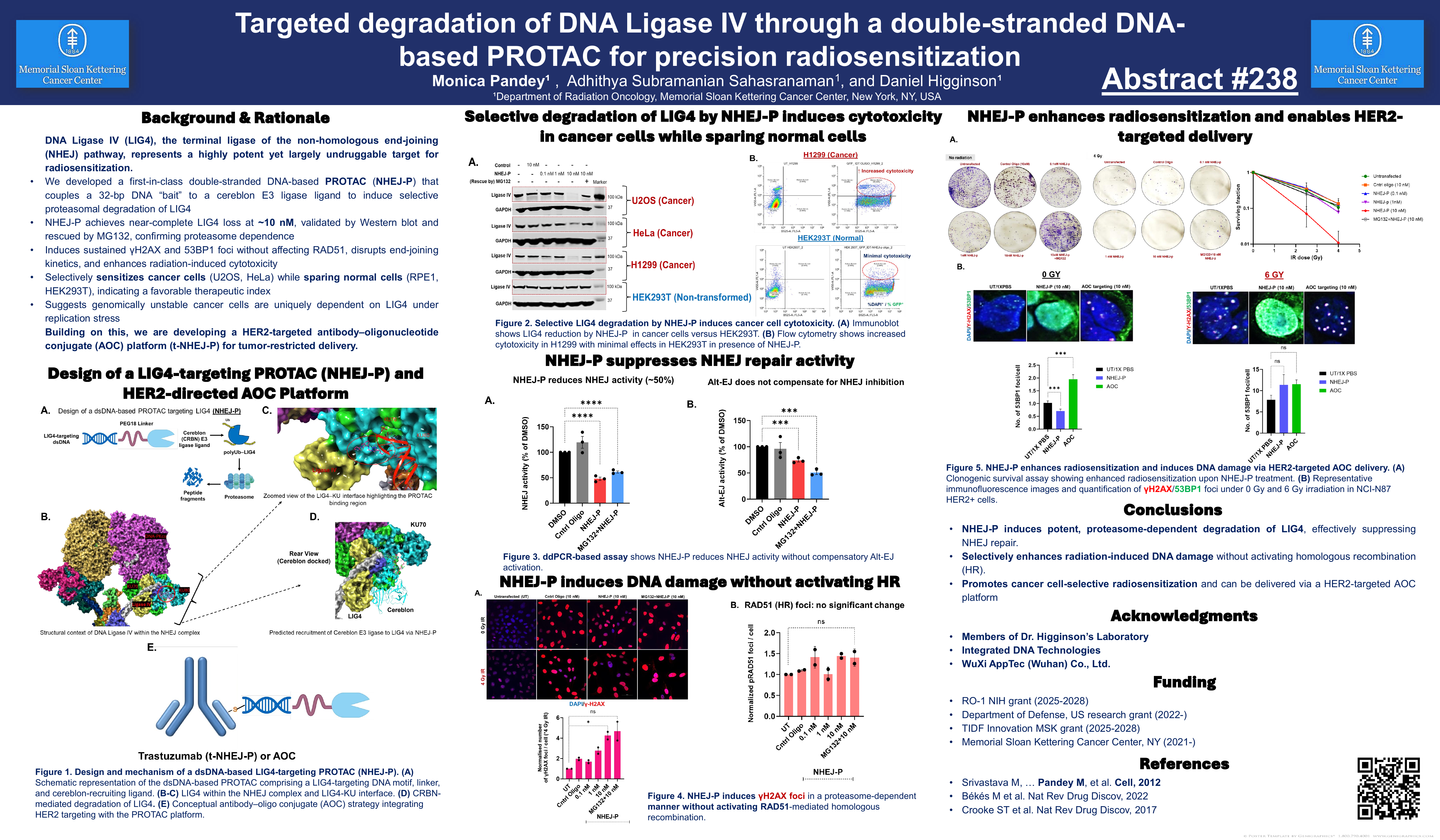
DNA Ligase IV (LIG4) completes the terminal step of non-homologous end joining (NHEJ), the dominant pathway for repairing ionizing radiation–induced double-strand breaks. Despite decades of interest as a radiosensitization target, LIG4 has resisted conventional small-molecule drugging. We report NHEJ-P, a first-in-class double-stranded DNA (dsDNA)-based PROTAC that recruits cereblon to degrade LIG4, and t-NHEJ-P, a HER2-targeted antibody–oligonucleotide conjugate (AOC) built on the same platform for tumor-restricted delivery.
At ~10 nM, NHEJ-P produces near-complete, proteasome-dependent LIG4 loss in cancer cells, suppresses NHEJ repair without compensatory alternative end joining (Alt-EJ) or homologous recombination (HR), and enhances radiation-induced cytotoxicity — while sparing normal cells at matched concentrations.
Background: why target LIG4?
Ionizing radiation kills cancer cells primarily by inducing DNA double-strand breaks (DSBs). Whether a cell survives depends heavily on how efficiently it repairs those breaks. NHEJ is the dominant DSB repair pathway in mammalian cells, and LIG4 catalyzes the final ligation step that seals broken ends. Without functional LIG4, NHEJ cannot complete.
LIG4 has long been recognized as a highly potent radiosensitization target, but it has also been considered largely undruggable. LIG4 operates within a multi-protein NHEJ complex (Ku70/80, XRCC4, XLF) and engages DNA through protein–protein and protein–DNA interfaces that are difficult to disrupt selectively with small molecules. Our goal was to remove LIG4 from the cell entirely — via targeted degradation — rather than reversibly inhibiting its enzymatic activity.
NHEJ-P: a dsDNA-based PROTAC
We designed NHEJ-P, a dsDNA-based proteolysis-targeting chimera (PROTAC) comprising three elements (Figure 1):
- A 32-bp dsDNA bait — a sequence motif that engages LIG4 through its native DNA-binding interface within the NHEJ machinery.
- A PEG10 linker — spatial separation between the DNA bait and the E3-recruiting ligand.
- A cereblon (CRBN) ligand — recruits the E3 ubiquitin ligase to bring LIG4 into proximity with the proteasome.
NHEJ-P hijacks a natural LIG4–DNA interaction and converts it into a degradation signal. Structural modeling of the LIG4–Ku interface and CRBN-mediated ternary complex formation supported the design rationale.
Results
Proteasome-dependent LIG4 degradation
Treatment with NHEJ-P at ~10 nM produces near-complete loss of LIG4 protein in cancer cell lines (U2OS, HeLa, H1299), confirmed by Western blot. Degradation is blocked by the proteasome inhibitor MG132, confirming proteasome dependence rather than a transcriptional or trafficking artifact.
Normal cells (RPE1, HEK293T) show substantially less LIG4 degradation at equivalent concentrations, suggesting a favorable therapeutic index and raising the hypothesis that genomically unstable cancer cells under replication stress may be uniquely dependent on LIG4.
NHEJ suppression without compensatory repair
Blocking one DSB repair pathway often triggers compensatory activation of another — a common reason DNA repair inhibitors fail clinically. Three readouts show this does not occur with NHEJ-P:
| Assay | Finding |
|---|---|
| NHEJ activity (ddPCR) | ~50% reduction in a dose-dependent manner; Alt-EJ unchanged |
| DNA damage (γH2AX, 53BP1) | Sustained foci accumulation; ~2 → ~8 γH2AX foci per cell at 10 nM (Figure 4); proteasome-dependent |
| Homologous recombination (RAD51) | No significant increase across doses tested (Figure 4) |
Degrading LIG4 creates a repair defect that persists long enough to translate into cytotoxicity, rather than triggering adaptive pathway switching.
Cancer-selective cytotoxicity
Flow cytometry shows increased cytotoxicity in H1299 lung cancer cells treated with NHEJ-P, with minimal effects in HEK293T normal cells at the same concentration (Figure 2). This selectivity aligns with the differential LIG4 degradation observed by immunoblot.
Radiosensitization
Clonogenic survival assays show that NHEJ-P pretreatment enhances radiation-induced killing (Figure 5A):
| Condition | Surviving fraction |
|---|---|
| Untreated | ~0.75 |
| NHEJ-P alone (no IR) | ~0.40 |
| 4 Gy | ~0.30 |
| 4 Gy + NHEJ-P | ~0.10 |
| 6 Gy | ~0.35 |
| 6 Gy + NHEJ-P | ~0.20 |
LIG4 degradation is independently cytotoxic in cancer cells and meaningfully lowers the surviving fraction at clinically relevant dose fractions (4 and 6 Gy).
HER2-targeted delivery: t-NHEJ-P
Free oligonucleotide PROTACs face delivery challenges — nuclease susceptibility, poor cellular uptake, and lack of tumor specificity. We are developing t-NHEJ-P, a HER2-targeted AOC that conjugates the NHEJ-P oligonucleotide to trastuzumab for receptor-directed delivery.
In HER2-positive NCI-N87 cells, t-NHEJ-P enhances γH2AX and 53BP1 foci after 6 Gy irradiation — from ~10 to ~15 foci per cell compared to radiation alone (Figure 5B). This demonstrates that the dsDNA PROTAC warhead can be retargeted to other tumor antigens by swapping the antibody.
Implications
Degradation vs inhibition. A PROTAC removes LIG4 entirely, collapsing the terminal step of NHEJ. MG132 rescue confirms a proteasomal mechanism with implications for pharmacodynamic duration and radiation scheduling.
No compensatory repair. Sustained γH2AX/53BP1 foci without Alt-EJ or HR upregulation is the profile desired for a radiosensitizer that amplifies radiation damage rather than rewiring repair unpredictably.
Cancer–normal selectivity. Differential degradation and cytotoxicity between cancer and normal lines at matched NHEJ-P concentration addresses a central concern for DNA-repair targeting: toxicity to proliferating normal tissue.
Deliverable platform. t-NHEJ-P establishes a generalizable path — the same DNA-bait warhead retargeted via antibody conjugation — at the intersection of radiation oncology, oligonucleotide therapeutics, and targeted protein degradation.
Conclusions
- NHEJ-P induces potent, proteasome-dependent LIG4 degradation, suppressing NHEJ repair at ~10 nM.
- Repair suppression occurs without compensatory Alt-EJ or HR activation.
- Cancer cells (U2OS, HeLa, H1299) are preferentially sensitized relative to normal cells (RPE1, HEK293T).
- t-NHEJ-P enables HER2-restricted delivery for precision radiosensitization.
This work establishes dsDNA as a viable warhead for targeted protein degradation in DNA repair.
Acknowledgments
Members of the Higginson Laboratory; Integrated DNA Technologies; WuXi AppTec (Wuhan) Co., Ltd.
Funding
NIH R01 (2025–2028); Department of Defense US research grant (2022–); TIDF Innovation MSK grant (2025–2028); Memorial Sloan Kettering Cancer Center (2021–).
References
- Srivastava M, et al. (including Pandey M). An inhibitor of nonhomologous end-joining abrogates double-strand break repair and impedes cancer progression. Cell 2012. PMID: 22607907
- Békés M, Langley DR, Crews CM. PROTAC targeted protein degraders: the past is prologue. Nat Rev Drug Discov 2022. DOI: 10.1038/s41573-021-00343-6
- Crooke ST, Witztum JL, Bennett CF, Baker BF. RNA-targeted therapeutics. Nat Rev Drug Discov 2017. DOI: 10.1038/nrd.2017.179
How to cite
Pandey, M., Subramanian Sahasranamam, A., Higginson, D. Abstract 238: Targeted degradation of DNA ligase IV through a double-stranded DNA-based PROTAC for precision radiosensitization. AACR Annual Meeting 2026. Cancer Research 86(7_Supplement):238 (2026). https://doi.org/10.1158/1538-7445.AM2026-238